Monday, August 11, 2014

"By sea or by air--it's your choice."


Yesterday was from hell. Moving day from my old flat, shifting stuff to Dubai to be later sent to Kenya. The day before, the Indian chappie came to assess my stuff. I had asked him if we should do it over two days but he declared—“No. The guys will come in early, wrap and pack everything and then we will be in Dubai by lunchtime.” That seemed straightforward enough, as that was his business. I had already packed away the huge JVC stereo, Sony TV, kitchenware, clothes and other things. I also dismantled the cumbersome computer desk and TV/stereo stand, the kid’s shelf, my bookshelf, dining room chairs, the kid’s bed and the king-size bed.

The three lads arrived, armed with rolls of bubble wrap, rolls of cardboard packing material, a rusty tool box, and some plastic weave stuff to make a gunnysack. They took a look at me in my ankle cast and told me to relax and they would pack everything. They work was as fast as they could, but it was a daunting task. The problem was in the process of dismantling the wooden stand/computer desk/beds into smaller sections it made for more work. If we were just shifting from one apt to the next we could have taken the whole thing but now these guys had to break the wood into different packages.

Even though they worked at a steady pace, time went quickly. I was worried we would not be on the road at noon. I kept phoning my friend MK at Salihiya cargo to ask her when she took her lunch break. She said she was off from 2pm to 4pm. I originally found out about Salihiya from my Kenyan-Somali guy at work—Shafie. I was always having trouble with Kenyan customs at the airport and with excess baggage fees imposed by Emirates Air. Shafie told me to send stuff through Salihiya, a Kenyan-Somali-run company out of Dubai. I wondered how they got around customs and duty especially if they flew into Kenya, but these clever chaps flew direct with Emirates into another international airport in Eldoret—circumventing the nasty customs.

As the time ticked past noon I phoned her again. She told me that I would have to go to their warehouse because of the size of my shipment and assured me that they did not take an afternoon break. I had never been to the warehouse so I was unsure where it was. Never mind, MK assured me, I will text you the details. Everything was moved out into the hallway to be shunted on the elevator. I was left sitting on my stool as the last goods went out the door. All that was left was me, my mountain bike, two suitcases, and my old mattress that I decided was not worth shipping. Dust mixed with bits of ripped cardboard, flakes and larger pieces of styrofoam laid strewn all over the flat, two dusty carpets were all that was left. Vultures were hovering outside my door as I had left behind a humongous wardrobe, a love seat, mirrors, an unused trash can, a pail with cleaning liquids and other discarded knick knacks. 

The sun was setting as the lads finally loaded up the truck, which was driven by an older Pakistani guy. It was 6:30pm when we finally got going. Having driven this route ad nauseum over the past 7 years, most of the time I was dozing in the ADNOC bus or paying attention if I was driving. Funny but, I swear I saw things I normally wouldn’t pay attention to, new signs, men jogging beside villas, and a number of pretty Filipina gals. As we drove over the new Maqtak Bridge, I saw the huge gleaming domes that were the Sheikh Zayid Mosque complex on the right and I looked down on the oldest bridge that was built before this was officially the UAE.

Our vehicle was the slowest vehicle on the road—maybe 70kms/hr max—we didn't overtake anyone. I was trying to doze off but was awoken by faster cars honking as they passed us on the shoulder—now I knew we were slow! This pervasive heat was starting to get to me especially with the trucks inadequate a/c. The words –“You will see a light in the darkness and you will make some sense of this…” Well I certainly hoped so!
We had already been driving for an hour when I woke up just as we passed a huge sign telling us the distance to the various gates in Dubai. Our destination, Mamzar Gate, was still another 65 kilometers from where we were on the sandy outskirts of Jebel Ali.

Dubai on a Thursday night, the start of the weekend here, is not the time to be driving through Dubai especially on its busiest artery— Sheikh Zayed Road. It is busy most of the time but tonight it was chock a block.

I gave Muhammad the phone number for the warehouse. I thought something was amiss when he didn’t understand the Arabic of the warehouse guy—Abdul-Aziz (AA). Muhammad said the guy must be Russian. Knowing that most of the shipping staff was Somali, I found this slightly off-putting—didn’t bode well.
I read the text message from MK again and it just said—“Salihiya cargo warehouse is in Mamzar gate no 8. Contact person Abdul-Aziz.” We drove on past, Burj Khalifa, the tallest building in the world, past the series of malls, Ibn Battuta, Emirates Mall and just for confusion sakes, the Mall of the Emirates. Could not see the old landmark Hard Rock Café as they shut down many years ago. As we drove over Maktoum Bridge towards Deira, we were now in the heart of the Dubai emirate. Nevertheless, I had no idea where we were heading except that it was in Hamriya, wherever the hell that was.

We got to Hamriya area and Muhammad tried phoning AA again for directions but he didn’t answer. We got lost looking for Mamzar Gate 8, so Muh went around the traffic circle and pulled off into Mamzar Gate 1. I panicked and phoned MK as it was 8:50 pm and she would be closing the downtown office at 9:00 pm. I told her we couldn’t reach AA on the phone. She mentioned something about a mosque and told me to try AA again. We continued on to the next circle then did a u-turn came back to our first circle. Muh phoned again barking directions into the phone as we drove around the traffic circle 7 times –I was getting slightly nauseous as we drove up to the next circle then pulled off.
After 5 minutes, AA pulled up alongside us and led us off towards Mamzar Gate 8. It was actually the next circle but you would be hard-pressed to find it as we had to go through the circle then do a quick right turn off the road, drive past a mosque and after a left turn, there, hastily scribbled on a piece of cardboard was Gate #8. Unlike Gate #1 with a proper sign, police checkpoint, barricade and metalled road, here was nothing but an unlit dirt road with no security.

We pulled into what looked like a makeshift, run-down chicken-wire fence depot. I’m still looking for what I would call a warehouse. No a/c here and everything would be fried in the midday sun, including the workers. This was more like a shotgun shack. Crikey—now what? We were quickly surrounded by a motley crew of unshaven Pakistani guys in sweaty shalwar kameez, a few bare-chested Somali guys and other swarthy types who were lugging around various bulky-looking packages for shipping.
Muhammad and I stood around in +100F balmy night air as the Pakistanis guys unloaded my 25+ pieces. The Somali guy AA yelled at his charges to unload my shipment. He even had to roust them from the nearby trailer. Yelling, measuring of the boxes, items stacked high on the huge scale then weighed. The sweat was running down my back as I quickly soaked everything I was wearing. I talked with AA as my shipment was being weighed, debating over whether they should go by air or sea. 
"It's your choice," he told me." 
“Whatever is the cheaper way,” I yelled at him. It was agreed that the heavier ones would go by sea and the lighter ones by air.
Off to the side were three African guys, probably Somalis, who were busy making wooden crates for TV boxes. Finally after everything was weighed, AA barked for a calculator, then with some convoluted method involving inputting the boxes dimensions he could determine the volume they would take on the container. By sea would take a month, by air, they would be in Nairobbery the following Friday!

AA took the SONY TV box over to the Somali guys to get crated. “You will have to work out a price with them,” AA winked at me.
“100 dirhams,” the one guy said.
“No way, I only paid around 40 dirhams at your downtown office,” I said.
“What is your last price,” the other guy said.
“That’s my last. I ain’t paying 100,” I said.
They wouldn’t come down and I wouldn’t go up, so after much haggling, it was agreed that the TV wouldn’t be in a wooden crate. AA said it would be okay to send it in its original cardboard box by air.

It was 10pm when we got back into the truck’s cab and Muhammad turned on the a/c—we were both soaked. I was surprised when we finally got back to Abu Dhabi at 12:30 am that there were so many people out and about; cafés were still crowded, KFC, SFC, Tim’s, the Automatic Restaurants, and the shwarma joints were still going strong. It was well past my bedtime, I took a shower, hit the hay at 1 am, but it felt like I had been on an overnight flight as I collapsed into my bed. I’d had enough!

Being a nomad for most of my life, packing and moving has never been stressful but this time, I did feel deflated from the whole experience, perhaps because I had been in Abu Dhabi the longest--7 years! Now on to my next adventure--hopefully not a demented one!

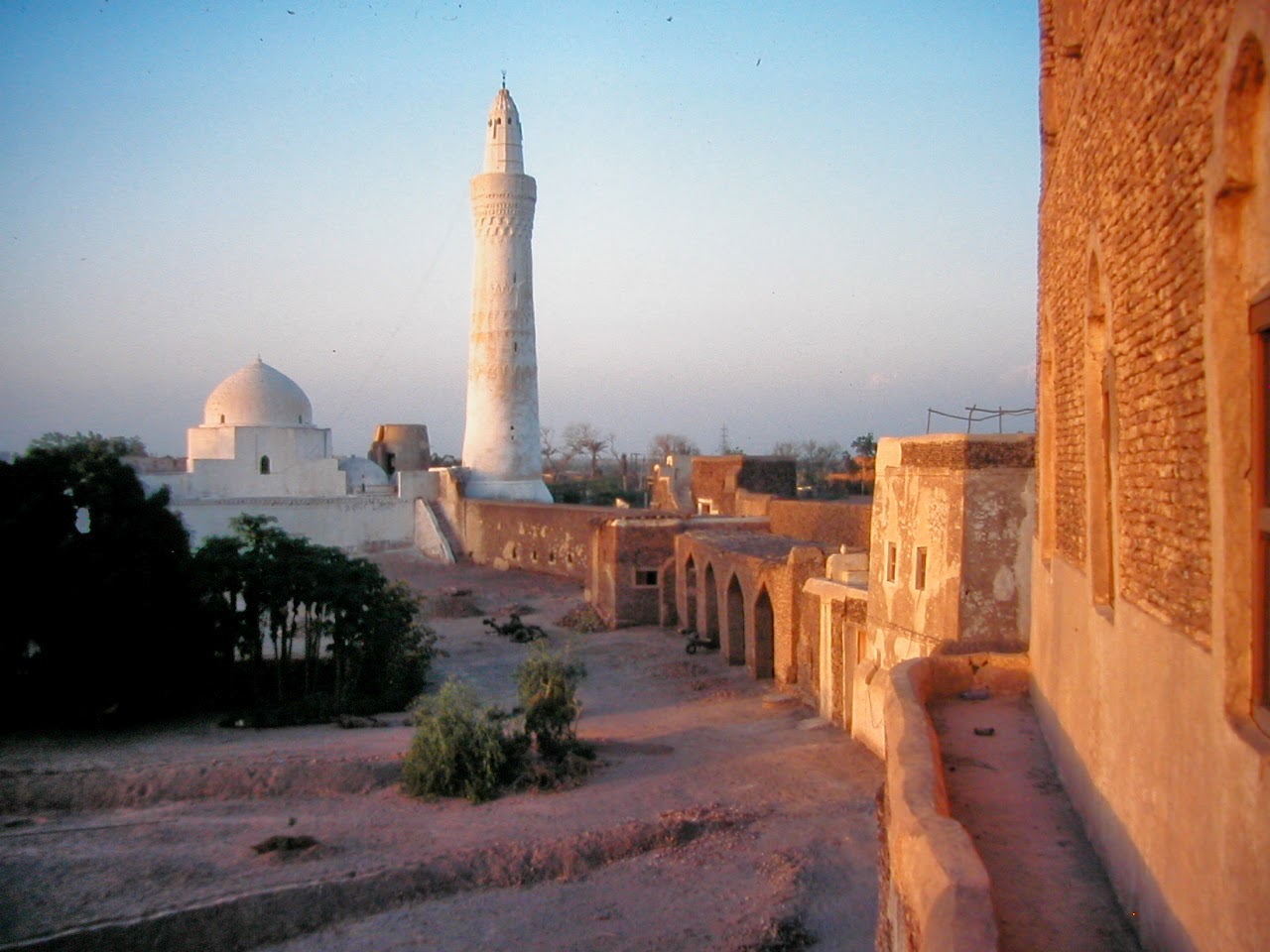
Wednesday, April 2, 2014

Last tango in Zabid, 1999


Last tango in Zabid, 1999.
Iskandar Mawz Mosque, Zabid
Zabid, and especially the Tihama, had been my first real experience in Yemen. I had spent almost four months here in 1996 as a site supervisor on a dig. I was excited to be going back there. As we got closer to the town of 10,000 people, there was no mistaking Zabid’s skyline with the bleached minaret of Iskander Mawz Mosque as the highest point and landmark.
In a translated account of Ibn Battuta, an Islamic traveller who had visited Zabid during his peregrinations in the fourteenth century, he reported:

Zabid is a distance of forty farsakhs [one hundred and twenty miles] from San’a and after San’a the largest and wealthiest town in al-Yaman. It lies amidst luxuriant gardens with many streams and fruits, such as bananas and the like… The town is large and populous with palm-groves, orchard--in fact, the pleasantest and most beautiful town in al-Yaman. (TMS 2000:84)
Looking south from the Citadel.
That was then but this is now. There was the same old nondescript hole of an entrance into the town, one of the four gates that still remained, we were welcomed with blowing sand. We fought through this entrance with a flock of grubby goats and a caravan of camels overloaded with enormous bales of cotton. On the way in, I did notice something new—an advertising sign for the Zabid Guesthouse and restaurant. Even though this was three years after my initial visit to Zabid, the town was still off the tourist map so to say. [i] Unlike Ibn Battuta’s 700-year-old account, I saw no evidence of luxuriant gardens, streams or orchards, just a dusty old town falling into decay despite its status as a UNESCO World Heritage Site. It was probably a safe wager to say that on this day I was the only ajnabee in the town.
We stopped opposite the old Citadel at a familiar site—the small shaded teahouse on the main square that I had frequented on my previous sojourn. Back then, it was the trees and shade that attracted me and our dig crew to this place, especially on hot afternoons and our days off when you would find us relaxing in the shade with fresh cool fruit juices, and chatting with curious local urchins. Often we came to get a lime mixer that we would later add to our sundowners back in the privacy of the Citadel.
I left Khaled to park the vehicle and went directly to the Citadel, wondering if there was anyone there who still might remember me. I noted that the Bab al-Kebir that led into the Citadel’s interior had a fresh coat of whitewash. I followed the dusty track lined with over-grown thorn bushes until I got to the old iron gate that secured the archaeological site and museum. But it was locked and no sign of a watchman. The place looked abandoned.
I was just about to give up when I heard voices coming from the old kitchen. I peered through the wire fence, I saw coming from out of the kitchen, a familiar face from the past. It was Muhammad, the son of Ahmed, our dig’s general handyman. Hoping he remembered me, I shouted out his name.
‘Muhammad!’
He looked at me oddly at first as if he was trying to figure out who I was and, more importantly, how I knew his name. It was time for a bit of my Arabic. In the best accent I could muster, I asked him:
‘Muhammad, wayn baba?’ (‘Muhammad, where’s your father?’)
He still looked dumbfounded.
Ana, Emerson,’ I said. (‘I’m Emerson.’)
Suddenly from behind, I heard a voice yelling at me. I turned around to find Jabbar, the Citadel’s guide, and Muhammad’s father, Ahmed (the handyman). Dressed of course in the traditional Tihama futa, Ahmed looked thinner than I remembered, but he was still wearing his oversized Sammy Davis sunglasses. He must have recognized me because on his face was a wide grin revealing a few more missing teeth and his cleft palate.
Kef halak habibi?’ (How are you my dear?) He asked.
Tamam,’ I said. ‘Al hamdulillah.’ (Fine, thanks be to God.)
Showing off the little bit of English he knew, he asked: ‘How is you?’
‘I’m fine. Kwayiss!
I stuck out my hand to shake his but instead he grabbed and kissed my wrist as a sign of respect. Then in usual Yemeni fashion we hugged. From a large clutch of keys, he took one and unlocked the gate. Once inside, I gave Muhammad a hug and couldn’t help but notice that since I last saw him in 1996 he had grown up to be as tall as his father.
We went to sit down at one my favourite spots to relax—a low plaster bench now thankfully in the shade outside the mudbrick kitchen. It was a godsend to meet these chaps and catch up on old times.
Wayn mudhir?’ (‘Where’s the mudhir?’) I asked.
Sana’a,’ said Ahmed, then he mentioned a common acquaintance, Johnny Al Bayti, a student whom I had met in the Islamic Archaeology course at the University of Toronto a few years back. Johnny was a Syrian-Canadian who had worked on the dig for years but had skipped the year that I was there because of security issues on the proposed coastal dig where he was to do underwater archaeology. As his Arabic was fluent he had now become the mudhir’s second-in-command.
Wayn Johnny, Muhammad and Abdul Habib?
‘They are here but on the coast,’ said Jabbar in excellent English.
‘When are they coming back?’
Inshallah,’ Jabbar said. ‘They should be here soon.’ In this culture “soon” could be tomorrow, next week or next month.
Then Ahmed interjected that they were expected back that very day.
‘When will the mudhir get here?’ I asked.
‘Maybe this week or next,’ said Jabbar. He probably had no idea when the mudhir would show up but was just being polite.
It would have been nice to see the old gang again but unfortunately, I did not have time to hang around. Our ‘programme’ had us continuing onto Ta’izz where we would stay tonight. I briefly considered spending the night here back at my old perch on top of the kitchen roof, but here in the Tihama where life usually moves slowly we were doing a whirlwind tour and time was ticking away. If we didn’t get going after this unscheduled stop, Khaled would be kicking his heels outside the Citadel chomping at the bit to get going. I decided to let him chomp. It was that old pecking order thing again.
Fatini, the cook with Carl
I took a closer look at the Citadel. It was definitely dustier and dirtier than when I had been here three years ago. The romance was certainly gone. The exterior of the old kitchen now resembled a jail complete with iron-barred windows, all of them shuttered and locked tight. The Citadel had been in a desperate state when the mudhir initially came fourteen years ago in 1982 to undertake a restoration using as much original material and traditional building techniques as possible.
Perhaps the reason the place looked so unkempt was because it had been dormant since the last dig season almost nine months ago. Walking through the dusty dining area, I could scarcely believe that this was the place where we’d had so many raucous and delicious mid-day meals that our pirate cook Fatini had lovingly prepared for us. Because there was no fresh air circulating now, there was a definite pong to the place. I poked my head into the kitchen where I used to cook breakfast for myself and the occasional dinner for some of the Yemeni staff. Egads, but I would not want to be cooking here now. Sadly, it now seemed quite grotesque and extremely unsanitary. Unfit for habitation actually.
Since my last trip, fluorescent lights had been installed inside and outside but their presence detracted from the mediaeval atmosphere of the place. This alteration in the ambience was due to more than the mere presence of the fluorescent lights—the whole place looked dilapidated: palm fronds were missing from the roof of the mudhir’s pottery yard, discarded sherds littered the terrace, and where Carl used to do his meticulous conservation of artefacts there was a thick layer of dirt.
Carl with the garden
A highlight of working here in 1996 had been the garden that the mudhir had planted. It had been a small oasis hidden within the confines of the dusty old Citadel. Back then, there were tall eucalyptus and papaya trees, a few banana palms, fragrant bushes of basil, and some nasturtiums, which I enjoyed nibbling. Every day Kathy and I would recline on wooden benches in the shade to take our siesta and get a reprieve from the dragon’s breath that blew in from the Red Sea every afternoon along with the occasional sand storm. Alas, most of my beloved oasis was disappearing before my eyes and with no more papaya and bananas to eat, I wondered if the huge fruit bats still flitted in the garden at dusk.
‘Ahmed,’ I asked, as I motioned to the spot where the papayas once stood. ‘Wayn papaya?
Finich,’ said Ahmed. ‘Mafi papaya! Finich!
Leish, mafi papaya?
Mafi faloose,’ he said. ‘Karaba kitheer.’ What he meant was that it cost the mudhir too much money to irrigate the papaya trees and banana palms which together would consume a considerable amount of water during the nine months when he was back in Canada. At first, Ahmed had earned some pocket money from the papayas, that is, if I did not eat them first, but now, as he settled down for his afternoon sheesha, he just seemed to accept his fate calmly, the characteristic of fatalism so common amongst the believers. Some things never change, Inshallah!
In the garden, I went for a stroll down memory lane. Many an afternoon—to get away from the blinding glare of the sun shining on the whitewashed buildings, and the oppressive heat of my trench outside the Citadel—I relaxed on a Tihama bed here in the cool shade. Then the garden had been lush with papaya trees, banana palms, and nasturtiums, now, other than some towering eucalyptus trees and a few scrawny bushes, nothing was growing out of the bare earth. It had not taken the good old days long to disappear.
My old sleeping quarters.
With the pervading heat plus the threat of catching malaria at night, I discarded my romantic notion of sleeping in the Citadel for the night. Not having packed my trusty old mosquito net was the clincher, but for old time’s sakes, I did go up to my old sleeping quarters on the roof of the kitchen to take some photos that I could compare with my shots from 1996. From this vantage point, I could barely see lower part of the Iskander Mosque as the eucalyptus trees were blocking the view.
Working in the Citadel in 1996 had meant so much to me at the time but I also remembered that it was a turning point in my life. My mother had died after a prolonged bout of pancreatic cancer only two months before I joined the dig because it seemed like a good idea to get away the all the grief I had felt back home in Toronto. At the time, I also knew that I probably would not pursue a career in archaeology. I’d had my fill of academia; the dig had its ups but mostly downs because of the irrational edicts of the mudhir. Without a doubt, this mudhir was the worst guy I’d ever worked under on a dig. Obviously, depending on your position in the pecking order it has its faults. As it happened, within a year, I would be back in the Middle East, but as a teacher of English as a Second Language and finally be making good money to be able to afford a trip like this one to Yemen. As an archaeologist I was always as poor as a mouse in a mosque!
Looking out over my old bailiwick, I felt I was cheating my memory by leaving after only a few hours. As much as I wanted to stay there, I still wanted to get the hell out of there. I bid the staff farewell, and headed back for the last time, perhaps, through the whitewashed Bab el-Kebir and there was Khaled waiting for me at the tea-house. I was licking my lips thinking about of the fruity cocktail mixes that we used to drink here on sultry afternoons chit chatting the time away, so I asked the tea-shop owner, ‘Mumkin mix? Cocktail?’ (Maybe mix, cocktail?)
Mafi cocktail,’ said the owner. ‘Khalas!’ (No cocktail! Finished!)
Apparently, since my last time here things had changed.
Just as we were leaving the place, Ahmed dashed over to say that Johnny, Muhammad and Habib had indeed just arrived at the citadel. Khaled rolled his eyes at another last minute delay. I hurried back to the Citadel for a quick reunion with my ‘Yemeni boys’.
Muhammad still had the huge Cheshire cat smile and Habib was his usual quiet self. Their shabby appearance had not changed a bit but their English had improved dramatically.
‘How are you?’ I asked
‘We are fine and you?’
Kwayiss.’ I said.
They both laughed at my Arabic.
Johnny was still the same lanky dig rat that I knew from our days at University of Toronto. We chatted a bit and then headed off to the newest watering hole in town—the Zabid Guest House whose advertisement I had seen on entering the town.
The Zabid Guest House was the place in town to cool off and relax in the shade of an expansive barasti roof. This guesthouse was a welcome addition to Zabid’s meagre social scene. It was not around when I was last here. It even had two pool tables that Johnny told me the ‘boys’ would shoot pool after a day’s dirty work on the dig. I was a bit surprised to see women with uncovered hair working here.
‘Who are these women?’
‘They are local women.’
‘What are they doing here in the guesthouse?’
Winking and giving me a nudge, Johnny said slyly, ‘You know.’
It did indeed look like one might be able to flirt with some of the Tihama gals that were working here, or at least that was what Johnny intimated to me but in this conservative society, I found it hard to believe!
Over cold soft drinks, Johnny and I talked at length about the state of archaeology, Muhammad and Habib were able to join in as they had been studying English at the American Institute in Sana’a. We discussed the pros and cons of archaeology as a career and Johnny asked me why I had left archaeology.
‘Because I couldn’t get steady work,’ I said. ‘I was tired of waiting for contract work on the West Coast in British Columbia. Instead I did a TESL certification course and soon found full employment in Korea then six months later did a runner to UAE.
‘Besides I’m a Near Eastern archaeologist,’ I said, ‘and if I worked on the West Coast, I would be at the bottom of the pecking order, I’d have to start all over again learning a new material culture of Canada’s First Nations.’
I told him how once my friend Serge and I had worked on another friend’s dig in northern Ontario near Temagami where after a mere foot of digging, I had hit the bedrock of the Canadian Shield. There were no historical levels here to interpret, unlike a site northern Syria in 1992, where we excavated a multitude of occupation periods and destructions levels to a depth of more than five meters and we eventually dug down to 10,000 year-old Neolithic layers. Johnny sympathized with my plight.
Johnny told me all about how he was trying to persuade IMF officials to part with their money for various reconstruction programs in the Citadel and the adjoining Iskandar Mosque. I wished him luck on that as that seemed an insurmountable task.
We had just gone outside the guesthouse to say our final goodbyes when unexpectedly we ran into our old night watchman, Misgagi. He hadn’t changed a bit since I last saw him in 1996. Johnny then told me that Misgagi had lost his baby girl during Ramadan, which must have been difficult for him and his wife. In watching the ease with which Johnny could converse with these locals, I realized that, as a site supervisor, he had one huge advantage over me: he could speak fluent Arabic and I couldn’t.
On reflection, maybe Johnny and I were living in a make believe world of archaeology. I always hoped that I could make a living at it but, in reality, without a PhD, most digs lasted only four months, and thus one was forced to constantly live from dig to dig. Despite that, I always loved the time I spent on archaeology in the Middle East and missed that bohemian lifestyle. To me archaeology never seemed like a job, but a passion. It was never difficult to roust yourself each morning to work on a dig. At a lecture I was giving on archaeology, someone once asked me what was the most interesting object I had ever found on a dig; my answer: ‘The next thing I uncover.’
Finally, we bade each other farewell, promising to keep in touch, which, unfortunately, we never did. [ii]
When I got into our baking vehicle, Khaled floored it out of there.

Friday, March 28, 2014

Pecking Order on the Zabid dig, 1996.


Pecking Order at the Zabid dig, 1996.
After a few weeks of excavating in my trench just outside the Citadel’s wall in Zabid our ‘dig season’ was well underway. Acclimatizing was tough because the temperatures bordered on unbearable. Daytime temperatures could easily be over 40 degrees Celsius and this was further aggravated by the dusty afternoon wind that accompanied them. Nor did it help matters that the mudhir proclaimed another edict that we would be allowed only one shower per day. Considering that we had no fans or air conditioning, and that I completely soaked my clothes in sweat at least three times a day, this did not sit well with me nor especially with Kathy, who took umbrage at another of the mudhir’s typical unilateral decisions.
Naturally, there was your typical weird group dynamics amongst our ‘western crew’ where everyone tends to get on each other’s nerves with their various peccadilloes.
The mudhir was proving to be a tyrant supreme at all times much to the discomfiture of Kathy, me and others. Our group dynamics were challenging at the best of times and in way, we felt like we were prisoners of this old Ottoman citadel which had indeed at one time been a prison.
Luckily for me, the mudhir was leaving me to my own devices and I only saw him once a week or so. Visitors to my trench just outside the citadel's east wall were few and far between. In working with my local workers, one day I recognized a definite group dynamic amongst them. What intrigued me was the pecking order they had established.
Some of the tension between my twenty workers might be attributed to work experience and either racial or tribal affiliations. Even though everyone was local, individually they were as different as chalk and cheese. Nevertheless, my workers were an amazing lot—a real mish-mash of ethnicity.
'Eddie Murphy with his wheelbarrow
However, the darker-skinned workers, who were of African origins, were relegated to doing the most menial of jobs, such as hauling mounds of dirt that had been created by the pick men, or running the wheelbarrows, or carrying the rubber dirt buckets.
One of my wheelbarrow guys was a dead ringer for the African-American movie star, Eddie Murphy, so that was the name we called him.
Eddie Murphy at our trench
He did not seem to mind and he probably had no idea of who the movie star was but maybe enjoyed what little status it brought him. At any rate, I was surprised by the number of black workers we employed, about one quarter of my work force.
Given the proximity of the African continent which borders the Red Sea, it’s only reasonable to assume that African seafarers, from time immemorial, had plied their trade up and down the Tihama Coast, and had no doubt contributed to the gene pool through assimilation. Also, it was during the time when the Axumite Empire controlled most of the south-west Arabian Peninsula (c. 325-702 AD) that the conquering Abyssinians (Ethiopians) had undoubtedly mixed with the indigenous Arab blood.
The Ziyadid dynasty (818 to 989 AD) controlled the coastal plain of the Tihama, and had established trade links, including the slave trade, across the Red Sea with Abyssinia. Some of these slaves, originally from the Jazali tribe in Abyssinia, rose up and killed the last Ziyadid ruler and by 1021 AD had established a new dynasty—the Najahid dynasty, which lasted until 1158 AD. During the later thirteenth century, Zabid was a center for slave-trading.
The social hierarchy of Zabid was just as complex. The ruling elites at the top of the pyramid were referred to as al kabir or ‘eminent nobles’. They came from bayt kabir, noble house. The ‘top’ families, who were rich and influential and called the sadah and kibar, were the next class. They were followed by 'freed slave' families. At the lower end of this hierarchy were the abid or ‘ex-slaves’ called mazayanah. At the very bottom were the darker skinned akhdam or ‘min al-Habasha’, who referred to themselves as ‘Ancient Abyssinians’ and they worked as servants or, as on our dig, did menial and hard-labour jobs. No doubt, the man we called ‘Eddie Murphy’ and our other ‘black’ workers were direct descendants from these earlier African slaves.


Another of these abid men who ran a wheelbarrow was called ‘Jonglei’ by the other pick men who, no doubt, thought they held a higher position over him. I had heard this term ‘Jonglei’ on a dig last year in Jordan where workers referred to one guy by this name. Moreover, I was familiar with the term ‘Jonglei’ because it was used to describe the massive swamp in southern Sudan that I had traversed on an overland trip in 1982. The ‘Jonglei Canal’ was a huge program undertaken by Chevron to cut a route through the swamp and speed up the flow of the Nile and provide an easier passage.

Through an interpreter, this ‘Jonglei’ chap told me he got this nickname from his great-great grandfather who had originally came over to Yemen from Sudan, perhaps even as a slave for the Ottomans. I preferred to call him ‘Sudani’. He was a sturdy looking chap and I would not want to mess with him. Luckily for the other workers, he had a good sense of humour about their playful joking.
My interpreter--Turki at his home.

The next group going up the pecking order were the men who used the large picks and shovels. My favourite worker named ‘Turki’ belonged to this group. ‘Turki’ looked quite different from the others perhaps because of his Turkish ancestry. He had lighter skin, soft grey eyes, a humourous disposition and one important advantage he enjoyed over the others—his excellent command of English.

Of course, I made him my interpreter, and when I asked him where he had learnt English, he answered with pride that his father had taught him. His lineage was probably connected to the short period when the Ottoman’s ruled this territory 1530-1536 AD when the minaret was built.

The men who used small geological picks and trowels were at the top of the pecking order. They were uniformly of Arab stock not African. They were the ones who had worked their way up the ladder for the mudhir on earlier digs and now they got to order the other workers around. They also tried to create as much dirt and heavy lifting work as possible just so they could sit and smoke a cigarette while ordering others around during their lull in work. Now and then an ambitious young buck from a lower group tested the waters by trying his hand at troweling, but this usually ended in mayhem with a strong rebuke from the trowel man. At any rate, there was constant chatter in our trench between different workers and a lot of joking around.
At the top of this pecking order were my two Yemeni junior archaeologists.
My ‘Yemeni boys’, as I called them, were from the two dominant North Yemeni tribes: the Bakil and the Hashid. One of my duties as ‘Site Supervisor’ was to teach my ‘Yemeni boys’ who had university degrees the finer aspects of archaeology—how to survey a site, set up control points so that we could correctly measure how far we had dug and also for giving the provenience of found artifacts and other material culture. To a certain degree, my ‘Yemeni boys’ took satisfaction in being able to order these Tihama workers around, no doubt proving to them at least that the North Yemenis were superior to these coastal bumpkins. I suppose one could say that I was at the top of the pecking order but the mudhir had tasked me with this job. Regardless of their social standing, I always treated everyone with respect, otherwise they might not work for me.
Near the end of the dig season, there was some excitement on the dig one morning. At any one time, I might have three trowel men picking away at something in three different locations. Since one of my duties was to carefully label and bag any artifacts found plus record their provenience, through surveying I had not been paying attention.
The older worker and 'Eddie Murphy'.
Suddenly there was some shouting going on when my back was turned and I wasn’t sure what was going on. Apparently, when one of the older and frailer bucket men had turned his back to load his wheelbarrow and Abdul, who had been working next to him, threw a small clod of dirt at him which exploded upon impact. When the workman turned around to see who had committed the act, Abdul would pretend that he was working. This went on a few times and it was funny up to a point as everyone was laughing but the workman was clearly getting fed up with being the butt of all the joking.
My workers and the 'Yemeni boys' supervising.


The others finally told the older man who the culprit was, there wasn’t much he could do

 because if he threw something back at Abdul this would have led to some kind of further

 abuse or maybe his firing. Things settled down and while Abdul was busy doing some 

troweling, I decided to exact some kind of revenge for the bucket man. 


While Abdul’s back was turned towards me, I winged a big clod at it, then I too pretended to

 feign working as he looked around for the culprit. The whole place roared. As Abdul was

 bellowing, I threw another clod at him. The entire crew erupted again but Abdul, realizing

 that it was I who was the culprit, even joined along so that was the end of that childish 

prank. Since I was the mudhir of the trench—he who must be obeyed—Abdul could do

 nothing. Things cooled down after this and there was no more dirt throwing by anyone,

 thank god! 

The only place to be in a pecking order is at the top.