Monday, August 29, 2016

Into Al-Shebab Country


Another Coast Trip, 2016

Into Al Shebab Country

As the last time back in 2013, we did the same overnight bus trip from Nairobi, but this time we took the Buscar express all the way to Malindi. It was a nondescript yet noisy ride at that as the drivers (two) insisting on playing Swahili taraab and Hindipop music at mega volumes. I suppose they did this to ensure that the drivers, whom I suspect were high from miraa anyways, from falling asleep at the wheel. But I fear it was to keep us paying customers awake too. Nondescript that is until the driver had to swerve to avoid some “mad” person who stood in the middle of the narrow two-lane highway just before sunrise. Well that certainly woke me up after I finally managed to fall asleep. I noticed that for the most part, Jessica was awake for most of the overnight drive.

We arrived in Malindi around 9 am, gathered our luggage and hired two tuk-tuks to take us to our old favourite haunt from our last trip—Tamani Jua. Apart from some other Italians, whom are probably residents here, we were the only paying customers at this Italian-run resort. Surprising since I thought this was the “high season”.

We had decided to break up two hellacious bus trips with an overnight in Malindi. Gracie decided that we would rest up for a bit and then go for a brunch back in Malindi. We sorted out our rooms and showered then went for a brief kip. We would eventually have a fine feast of chicken and chips with fresh passion juice and kachumbari which is the Kenyan equivalent of salsa at the Barani Restaurant. We were famished and I was amazed at the speed that they brought us our meals—all six of us within minutes.

Nevertheless, it was great to be on the coast again as it was quite balmy compared to frigid Nairobi and its ‘sharp showers’, and its cold nights spent huddled around the electric fire watching nauseating teen dramas, Nollywood hocus pocus juju dramas and endless re-runs of cartoons on Nicholodean.

We left early the next morning bound for Lamu.

Lamu

It’s been 14 years since I was last here in Lamu and 32 years since I first came to this island. Lamu Island is part of a greater archipelago of islands stretching like a necklace from here almost to the Somali border which is not that far away. In fact, we are a little west of the old UNESCO World Heritage site of Lamu, in the smaller town of Shela. Even though I have been coming here for years, it is actually my first time staying in Shela.

Coming to Lamu was my first exposure to Islam and Muslim culture. To be clear, it is really Swahili culture: a mélange of mainland Bantu people, some exotic spices of Persian, Zanzibari, Comorian, Omani, Yemeni and far eastern extractions along with the indigenous, if I can call them that, Bajuni folk who inhabit the string of pearls that form the Lamu Archipelago.

However, I will not be taking this bus ride from Malindi to here anytime in the future as this bus ride beats the crap out of you. The 14-hour bus trip from Nairobi to Malindi is quite enough even on good tarmac. The rest of the journey from Malindi to Mokowe is more like an endurance race for the body. I thought the old Arusha to Dar was the worst bus ride I had taken and from Kapiri Mposhi to Lusaka is not roaring hell either—with potholes that can swallow a Mini Cooper. This Kenyan version is something akin to a boat ride—quite rollicking. If you suffered from car sickness—this ride is not for you at all. And by the time you reach Mokowe, the last bit of Kenyan mainland before Somalia, you feel like you have been put in a tumble dryer for 4 hours. What surprised me most of all was the stoicism of the fellow passengers, some having to stand for portions of the trip, and the sheer battering that our Buscar bus has to endure. I wonder what the life expectancy of these buses are.

The first time I took this journey, and for a few after was with Tana River Bus service, but I don’t see them running anymore. I did see another bus company I used before called Tawakal, but I think they are a larger firm who are a national bus company.

My wife deserves some award for taking this longish bus trip sometimes every week—I think I would check into the loony bin if I had to do that or replace my battered ass. Maybe Jessy and Jeremy deserve a medal for enduing it too. Luckily we had brought along some mandazis, packets of UHT milk, water and a few biscuits to stave off hunger on the longish drive.

The only thing that broke up that monotony, if that’s what you call being thrashed about, are the police /army road blocks where everyone except the burka gals had to alight from the bus to get checked out. There are two smaller police checks outside of Malindi where the road is still good then two larger ones near Witu and Kapini where the road, if that’s what you can call it, has disintegrated. These roadblocks are manned by Kenya’s finest: a woman soldier for femmes and a brute of a guy for men. They actually checked my passport to see if I was indeed Emerson Gronk. The female soldier also looked at my passport and thumbed through it looking for my entrance visa and asked—“You are here for 3 months?”

I was surprised and just said—“No, just 2 months.”

At the second roadblock, they separated the Kenyans from the wazungu (foreigners). I had to get in line with a bunch of Chinese who were travelling en masse as they are want to do—and they are most welcome to it. We had passed by Coast Bus which seemed packed to the hilt with them—they, the new travellers or new colonizers of Africa. Damn exploiters! Harrumph!

I had to laugh as the Kenyan sergeant asked each one of them their age and name. Laugh, because he found their accent funny and he didn’t know how to spell their names. The last gal, a little princess, was a tad rude when the guy asked her age, she chipped back cheekily—“You can read it in the passport.”

Of course he could, he just wanted her to say it in Inglisi pleezi.

Make no mistake about it—we were in Al Shebab country after all. Over the recent years, the Shebab had shot up a number of buses on this route and terrorized villagers in the Witu, Kapini area plus did a bold attack on Manda Island just opposite where we would be staying in Shela, and in the process, kidnapping some French tourists. Mind you, that was a few years back.

Since that time and the Westgate Massacre, peace has been restored in this area (we hope). Especially with the Kenyan Army joining the OAU, and for lack of a better word, invading southern Somalia. In the past bus trips, this bus trip went through the land of the shiftas. Those rag tag bunch of rogue Somali soldiers, who shot at and then robbed the buses. From 1986 onwards there was always a couple of Kenyan army guys who rode the bus. Nowadays, we get an army escort from the first checkpoint to the last one just outside Mpekatoni. Mind you, once we set off it is like an opening scene from one of the Mad Max movies as each bus is shuttling back and forth to see who will be the first one in lead so that the other busses and occupants eat their dust. The road is a dusty, teeth-rattling, corduroy affair.

Around Witu, the highway really cuts through a jungle—maybe the last remnant of that great Equatorial jungle which stretched from the Ivory Coast to here and I can see why Al Shebab chose this particular region to attack. It would be virtually impossible to detect them given the ground cover provided by the dense bush—albeit thorn tree or scrubland. At times, some of the thorns and leaves showered down on us through the windows as the bus lurched dangerously close to the sides of the road, scraping the bus in the process.

We did see some baboons lazing about in the swampland and then later saw a troop off on a dusty, lonely track that lead nowhere. I did see some grey-haired macaque monkeys up a tree as we hurtled along.

This is, without a doubt, one of the loneliest stretches of land if not in Kenya, perhaps in Africa. Hardly any signs of settlement and one wonders where the hell people are going when they get off in the middle of nowhere with no huts in sight. Where the land is arable there are great swaths of corn growing as it is one of the staples here—a tough, what I would call cow corn, that is dried and ground up into something resembling a thick, wall paper paste with a taste not that dissimilar—called ugali.

It was from this part of the journey that we took on more passengers than there were seats. As mentioned, some of those either stood for a portion of the ride or hoped to get a seat once some passengers alighted, in the middle of nowhere nonetheless. The driver didn’t dally too long and with a honk and banging on the side of the bus by the ticket taker, it meant time to go with the ticket taker usually running and hopping on at the last moment.

I was curious about one young guy who got on with his New York Yankees baseball cap at a tilt, holding firmly onto what look like a sound board. Perhaps he was a singer or a musician. What perplexed me was where he was going, what show he was doing and would the small hamlet have a steady flow of electricity—somewhat a bane of this country wherever you are. It’s seemed odd to be hucking around a soundboard that is until he alighted at Witu, where upon I saw his mates help offload four largish speaker cabinets and other parts of the sound system. Just the same, at some point, we did pass a small collection of mud and straw huts with a small crowd of thirty or so villagers gathered around a solo speaker or singer who was either an evangelist doing an open air sermon or maybe political rally, or perhaps some mini concert.

We finally arrived at the end of the road at Makowe. The town is built up since I last rode the bus to here. Before, you would just come to end and there would be the jetty which you would carefully have to navigate your way down as barnacles had grown from the high tide and it was a tad slippery to descend to an awaiting large dhow called a jihazi which would take you to Lamu just across an inlet where the Lamu touts would wait to pounce on you once you landed. However, this time the touts pounced on you as we alighted from the bus. Naturally they swarmed around me—the only mzungu on this bus. Times have changed.

I had to laugh out loud when they unloaded our luggage from under the bus—it looked like it had been through a war—it was all covered in a heavy dust from the dirty track we’d been on for the last four hours.

Our group, all six of us, and our seven pieces of luggage were stacked on a small motorboat and they carefully helped us onto the powerboat. It was the first time the kids and the maids had been on one and Gracie made sure that we all got life vests except for me. It’s because, apart from Jessy and myself, none of our entourage know how to swim despite the adults growing up on the shores of one of Africa’s Great Lakes and as I so righteously declare, along with that British explorer guy named Speke, the Source of the Nile—Lake Victoria. Nevertheless, the ride was quite choppy owing to the high waves caused by the winds that had kicked up by the kazi wind.

We bumped along and the kids really enjoyed their first taste of salty air with Aunties Lynette and Beatrice holding firmly onto the side of the boat for fear that we would capsize. It’s the first time I have come into this place with my back to Lamu.

There is something to be said about arriving at a destination by boat—beats the hell out of by bus, car or plane. I think that old kayaker and travel writer Paul Theroux would approve.

We zoomed by dense mangrove stands that made loud sucking noises, tidal pools and then close to the Lamu’s corniche with a stunning backdrop of bleached coral rag buildings gleaming under the African sun of Lamu’s old Stonetown, and a first for me, as we sped towards our final destination just west of Lamu called Shela.

Once we docked next to Peponi’s, the ultra-tres chic resort, we were swarmed again by other Bajuni touts who offered their eager hands to shuttle our luggage to our guest house—Bait il Aman guest house. Like Lamu, Shela is a maze: a labyrinthine of coral rag houses. One can easily get lost here and luckily=y we had these guys to guide us.

As we started off a chap stepped forward, with a wide smile and grabbed my hand—it was our old friend Edward who had previously set up our accommodation and stay at the guest house he was now working at. Gracie had known Edward for some time as her fish business had put her in touch with him some 17 years ago. He was also the head guy at our old retreat of Stone House. I had met him there back in 2000 with Mike Bowie. I had met my wife there too. Lamu is full of such memories, most romantic ones too!

On the boat trip over, I noticed that there were more Swahili houses, actually huge mansions that the rich Euros had built on Manda Island. When I first came to Lamu in 1982, there were no such places on Manda—only the deserted sun bleached collapsed ruins at Takwa. On my last visit here in 2003, that Swiss guy named Joe had built the Manda Island resort and that was the only building on the island—how times have changed. Also, there was a proliferation of speed boats bombing up and down this busy passageway of water.

Edward, and our growing group of lackeys plus gear, headed off after a number of guides offered their services for day trips to Takwa, donkey rides, fish BBQ on Manda Island, and sunset cruise.

Lamu and Shela had suffered in recent years because of the Al Shebab insurgencies and terrorist alerts issued by British, French, Italian, American and Canadian foreign offices. We had docked next door to the famous Peponi’s Hotel which I had heard had just opened for the summer with over 300 guests expected—perhaps things were looking up.

Lamu had been dubbed “the Kathmandu of Africa” by the Africa on a G-string guidebook in the 1980s. True. There were some very up-market restaurants and cafes on the island back then: New Mahrus Hotel, The Pancake House, Kenya Cold Drinks, Petley’s, Mr. Ghai’s Curry House and the ever so posh The Equator, which even accepted American Express cards and I know that first hand as I treated my younger brother and then gf to dinner there. The Equator resembled the inside of a dhow that had been cut in half, with the owner, Ron, an eccentric British Kenyan, who sounded like Vincent Price and played Beethoven 78s on an old gramophone. It was a tad expensive—you needed an AMEX card to pay for the extravagant meal.

Those places are long gone and so is Lamu’s old claim to fame.

We did pass a number of wazungu en route to our guest house. Maybe times had changed and the tourists were coming back—thank god!

After zigzagging a few times past donkeys, scruffy kids and donkey do, we finally arrived at our destination for the next month or so—Baitil Aman Guest House.

Edward showed us to our quarters which were up on the second floor. To describe it as spacious would be an understatement—our accommodation could easily sleep two large families. The maids and the kids each had their own generous and ornate traditional Swahili bed, but they would share just two beds. Gracie and I had the honeymoon suite with walk-in mosquito net and en suite bathroom. There were two additional beds should Gracie’s siblings decide to show up (They never did). Two huge bathrooms with shower, linen and towels.

Yes, it was good to be back on the Swahili Coast!

Thursday, August 25, 2016

Old friends in Lamu, 2016.


Day 4 Friends from the Past

Apart from dodging, some cockleshells, barnacles, broken glass, donkey shit, abandoned flip flops, and shells at low tide, the preferred mode of transport to Lamu is by boat—all be it a high powered one if so inclined. There were no power boats here in 1982, everything was done by sail and the mercurial winds of Manda Strait. There was a huge ocean-going jihazi dhow that was powered by a noisy, greasy diesel engine that took backpackers and other mzungus from the last bit of Kenyan mainland to Lamu.

My return trip here in 2000/2001 saw the first power boat which belonged to the Prince of Monaco. He used his power boat to jet over to the Manda Beach Resort to try and turn down the music from German Joe’s Disco and, if that did not succeed, punch out his lights, so to say.

For you maritime lovers and boatheads, the Mozambican dhow has now replaced the traditional dhow here and the locally-made fiberglass Chriscraft knockoffs are usurping those two boats with anything ranging from 15 hp up to twin 250 hp outboard motors.

Unless you are water skiing: I see no need for the speed unless you are outrunning Kenyan customs and involved in illicit mira or arms smuggling from Somalia.

Nevertheless, I boated over to Lamu in a fiberglass boat at a leisurely pace to run some errands. It was high tide and slightly treacherous underfoot to, and at times, one would have to crawl along the sea wall in an epic walk to Lamu, so I opted for the power boat. There was a strong tail wind as we powered along, but it felt like we were underwhelmed by our whopping 15 hp motor. The captain managed to hit every wake of faster, heavier power boats that clipped along and easily passed us. To avoid those brutes, we hugged the shore, so as to not to hit too many oncoming waves.

As we got nearer to town, the concrete walls gave way to a new paved corniche that now leads into the old town of Lamu. We passed by a few hawkers who were selling fruit, hard candies, tepid sodas and other sundry items they could cart around in the shade. We boated by the huge, yet now empty edifice and faded stencil of Lamu Ginners which to me sounded like a place where they made gin, but I think it is some godown for making cotton or something. The place looks as deserted as the last time I was here and was overgrown with umbrella acacia, scarlet bougainvillea bushes and a vacant coral rag building which looked like a haunted house backdrop.

Further along, a few deserted dhows had been haphazardly thrown up on the shore, perhaps being vulcanized for parts or utterly abandoned—a bit of a dhow graveyard. Other newer models were just moored here alongside the older forgotten battered ones.

Off to our right moored near the island, was what looked like a floating barge or prop from Kevin Costner’s colossal commercial movie bust—Waterworld. I yelled “SMOKERS”, but no one caught on to the movie dialogue-pity! I was told it was a floating barge alright, but belonging to some crazy Brit who decided to have a floating bar and liquor store in the strait between Manda Island and Lamutown. Seemed like a daft idea to me—you would need a boat, skiff or dhow to get to it, but perhaps the Brit did this with the intention of avoiding some liquour law or tax evasion scheme. Lamu, after all, was an Islamic town, but alcohol could still be had at a few watery establishments at a premium price mind you.

We eventually docked at the main pier and I awkwardly got off the boat and onto the barnacle ridden concrete steps and slowly made my way into town. Naturally I was approached by everyone and their brother—all touts.

‘Jambo, my name is Yahya and I am offering a historic tour of Lamu.’

‘Donkey ride, sunset dhow trip for you today?’

‘Please sir, do you have 250 bob (Kenyan shilling) as I am a fishermen and need to buy a needle and thread to fix my net.’ ‘The other day you couldn’t help, but today you can?

‘Jambo. Where are you going? Let me help you find the bank.’

I had been to Lamu probably before some of these touts were born. I think I still know my way around here—or at least that is what I thought.

After my bank business, I made my way along the busy main street just off the wide open corniche trying to avoid donkey carts, garbage men pushing a handcart and shouting at everyone to give way, past others hawking cheap Chinese electronic goods, popcorn, roasted groundnuts and cashews, donkey doo, touts with blackened teeth offering city tours and other personal services.

At some point, while I was checking the internet in what was called a bookstore that sold electronic goods, a yelling match broke out just a few dukas or stores away. At first, I thought it was someone hawking their goods, but then it became a furious shouting match. Curiosity got the better of me, so I stuck my nosey head out the door along with the others in the shop.

A crowd had swelled with a local BuiBui woman yelling at an elderly Indian shop keeper, but it was getting beyond the shouting point to pushing and full-on confrontation that now spilled out onto the main street—stopping busy foot traffic and even the heavily-laden the donkey carts in their tracks. Some men were trying to restrain the women and who knows what had precipitated this, but it soon was resolved.

As I headed off to the new Seven to Seven supermarket, a huge figure clad in the traditional brilliant white Swahili dishdasha called kanzu stood out, especially in this darkened narrow passageway that is called a street in Lamu. It was like seeing Gandalf with his brilliant white hue. However, this man had an expansive smile one that you associated with familiarity—it was a face I have known for many years—my old friend Sheikh Ahmed Badawy. He’s the same physical size of a James Earl Jones and with the same over-powering baritone voice to go along with it.

I hadn’t seen the rascal since 2001.

I yelled out his name, “Sheikh Badawy” and he remembered me saying—“Where have you been?”

We didn’t greet the traditional way they do in Lamu, me bending down and kissing his right hand wrist as a sign of respect, but as old friends in a gigantic bear hug.

He asked if I still worked at Nexen in Yemen and I was surprised he still remembered that, but I told him I was in Doha now. He told me he had worked in Yemen at a university, but then was forced to leave because of the war between North and South Yemen in the 1990s. My erstwhile and erudite friend, and former mentor, Bill Curry had too been in the same situation, maybe even the same university, and he also had to do rapid evacuation sans his final payout. Mombasa Bill had explained the whole scenario to me over Skype awhile back, but somehow had managed to get compensated by the British government when he accidentally bumped into some head mucky muck in a British embassy. I wondered if Sheikh might not be entitled to the same compensation.

 We caught up on old times.

Since 2001, he had attained another masters in TESL from a British uni and was trying to get a job in the Gulf, but had been turned down by the University of Qatar. To soften the blow, I told him that I too had been spurned by them, but it was because of my age.

All of a sudden, we turned off from the busy street scene and entered a tight alleyway that lead north in the maze of Lamu’s side street of the Stonetown. We passed by dukas (small stores), no larger than a broom closet back home packed to the hilt and onto their steps with everything from phone cards, to Omo laundry detergent, sweets, tubs of Cowboy lard, withered chewing gums, packets of groundnuts, toothpaste, soap, …etc.

As we climbed the narrow alley, Sheikh, who is as tall as me, was stopped by a much shorter local who grabbed the Sheikh’s right wrist and kissed it. Then as I was looking at this old man’s bespectacled face, I realized that I knew him too.

We too shook hands and exchanged traditional greetings:

‘Jambo (Hello)’

‘Habari ako?’ (How are you?)

Or sometimes, because of their Arabian roots, ‘Salam alaikum’

It was an old Lamu friend Sayed who ran the Rainbow Lodge that Janine and I stayed at in 1988, but I had known him from an earlier trip when I took his picture in the doorway of the same lodging. Apart from Sheikh Ahmed Badaway, Sayed was probably the oldest friend I had in Lamu. Ali Hippy probably was the oldest since I first met him in 1982 when I got off the boat at the Lamu main pier.

The Rainbow Lodge probably closed during the down years during the 1990s when tourism literally went south, south to Zanzibar when Tanzania started to open up to tourism and capitalism after enduring many years of a grim form of African socialism under Julius Nyerere.

We talked briefly about the old days as others rushed by us and I didn’t want to detain him too long as he was carrying a 25 kg bag of cement on his shoulders, so we agreed to meet again. I told him I had a photo of him and he said just to give it to the Sheikh for safe keeping. Sayed still showed his two big front teeth when he smiled.

As we walked, the Sheikh talked about someone called Hadrami which made us talk about the Hadramawt where I had worked for Nexen.  He mentioned that he had been in Tarim and mentioned going to Gabr el Hud (The Tomb of Hud)—he was one of the early prophets. I told him, ‘I’ve been to Tarim and Seyoun, but my trip was cut short. They didn’t allow me to go beyond Tarim.’

Part of my 1999 trip’s itinerary was to go to Hud’s Tomb, but never made it as the Yemeni Army blocked that passage after Tarim. When I worked in the Hadramawt for Nexen from 2001-2003, we were forbidden to make trips outside our work camp as it would be considered as “grounds for dismissal” as my boss Bill Curry had told me in my interview.

The Sheikh and I had only walked a short distance when suddenly we turned left only to come upon a long line of men waiting to get into a house. On the left side of the narrow alley, in a small alcove, was what looked like a wooden cart with a stretcher on top draped in a fancy woven cloth with intricate gold and green embroidered Arabic script stitched onto it—no doubt some sura from the Koran.

Then the Sheikh explained that a very important person had died; the woman who owned one of the big resorts along Lamu’s Corniche. Initially, locals, mostly men in their kanzus had come to pay their respects to this woman. A little while later, a line of women in white veils also showed up and then once ushered inside the house, started singing praises to her.

The line of men and women grew and soon spread to where we were standing in the cross alleyway. Naturally, before and after paying their respects, everyone came to shake hands with the Sheikh and, because I was the only mzungu there, and an honoured friend of the imminent Sheikh no less, they were obliged to shake my hand too!

I must say that I felt somewhat out of place and a tad disrespectable, dressed in a tatty sweaty shirt and ratty shorts, but I did not know I would be meeting so many Lamu notables today. These were, for lack of a better word, the upper class or patricians of, if not Lamu society, then perhaps the entire Swahili society on the coast. Everyone had a pedigree of some sort going back to the founding of Lamu with my friend, Sheikh Ahmed, at the top of this pecking order.

After a multitude of greeting and salaams, we turned away from the busy side street to continue our walk to somewhere. It seemed like they would bury the body soon, but I had no idea when she had actually passed away.

I asked Sheikh, ‘According to Islamic tradition, isn’t the body supposed to be buried three days after death?’

“The family is waiting for her sons to return before the actual burial takes place,” he said, and continued, “you know they are spread out: one son is in Oman, another in England and one in Germany.”

We struggled up the side street which led to an open area with a plaster arch that we walked under announcing that we had arrived at the big mosque on the island. I had known that Sheikh Badawy’s ancestors, probably great, great grandfather had built this. Just inside the gate, we sat down on a concrete ledge that had a fresh coat of noora or lime wash on it, and for the next hour or so, the Sheikh regaled me with the history of this place—his history that is.

It was a blustery day here on one of the few hills on the island. A few grey cumulus clouds drifted by and it looked like it could rain again if only a quick sun shower. It had rained heavily yesterday when we got caught out in the squall that came in from the Indian Ocean. I mentioned the recent rains to the Sheikh, but he seemed to think it was a blessing. Perhaps they don’t get any rain here these days. I’ve never seen it rain here before in Lamu, but then, perhaps I was here during the ‘dry seasons’.

Some other men greeted him then sat down and chatted with the Sheikh, and were obviously looking and making some comment about me.

The Sheikh translated, ‘They want to know why you are wearing shorts in the complex.’

There was really no need to explain. If I had known I would meet the Sheikh and then be invited to a funeral in a mosque I would have dressed for the occasion, but he already knew that and had allayed their suspicions.

Again, as the faithful completed their prayers in the mosque, they passed by where we were sitting and stopped to pay their respects.

‘My great grandfather started this,’ he announced, swinging his right arm in a wide arc around the complex.

He pointed to what appeared to be a cinder block two storey house just at the corner of this mosque complex, “that’s my mother’s house over there.” There was another stucco and plastered arch with Momma Badawy’s house painted in green above it.

“I was born in that room up there.”

A motorbike drove by and I thought it was a tad disrespectful in a holy area especially when he beeped at no one—this left both us wondering who he was beeping at.

‘I don’t remember this area being paved with patio bricks,’ I said.

I said this while looking at some donkeys rolling in the sand just off the paved area. ‘Wasn’t this all sand before,’ I added. ‘I only remember this as sand and everyone sitting here at night reciting from the Qur’an during the Maulidi in 1986.”

‘Yes, you are right,’ he said, ‘I am planning to pave the whole area up to my mother’s place.’

I think he had got some kind of grant from a European or American agency. This was after all a World Heritage site.

Just then, some other African guy, not dressed in traditional kanzu came up, he looked like he was from upcountry, saying, ‘He was born up there.’

This guy looked a tad crazed, like he had been chewing qat. I don’t think he was Muslim, probably a tout, but I wasn’t buying anything he was selling as I was trying to listen to what the Sheikh had to say.

The Sheikh seemed to tolerate him, but nothing more.

I don’t even know if Sheikh knew him or vice versa.

Thank god he left. I felt uncomfortable being around the guy especially in the presence of his holiness.

At some point, some older gentleman came by with his entourage, and this time, it was the Sheikh who got up to greet him, as up to this point, it was the others who bowed to kiss his wrist, but this time the Sheikh did this. We shook hands and after the Sheikh explained that this man was the head of the mosque—perhaps the mullah or the religious sheikh of this mosque.

A little while later, an older crippled woman, held up by two crutches, struggled by us and the Sheikh shouted out a greeting to her, and when she was out of earshot, told me that he had taken her on the Haj many years ago.

The Sheikh kept peering back down the alley we had earlier walked up as if expecting someone.

‘I’m just staying here until they bring the body by as they go to the mosque.’

A little while later, the line of people coming into the mosque complex increased and then a procession of eight pallbearers in kanzus entered carrying the stretcher of green and gold embroidered cloth that covered the deceased. As they made their way to the mosque, the pall bearers changed positions with different men, all in freshly starched kanzus, taking their turn carrying the shrouded body.

I suppose it would be a great honour or sign of respect or both to carry the body of someone who had died. As they got close to us, the Sheikh stood up and he too joined in. He shuffled to the front of the men then shouldered the load for a short distance and then handed that duty over to some other younger man. They finally carried the body into the mosque.

I had a ring side seat and even the Sheikh was surprised that I didn’t have a camera or phone handy to take a shot of the event. We sat for a little longer then I bid him adieu as he most likely wanted to go into the mosque his grandad had built and pray with the others.

I hope to meet him again as I am here for maybe another month. He would be easy to find as he reminded me pointing up at one of the Swahili houses on the street just behind us, ‘Just look for the house with the red paint.’

Then he was gone again.

Tuesday, December 1, 2015

The Bedu of Tel ' Atij (Syria, 1992)


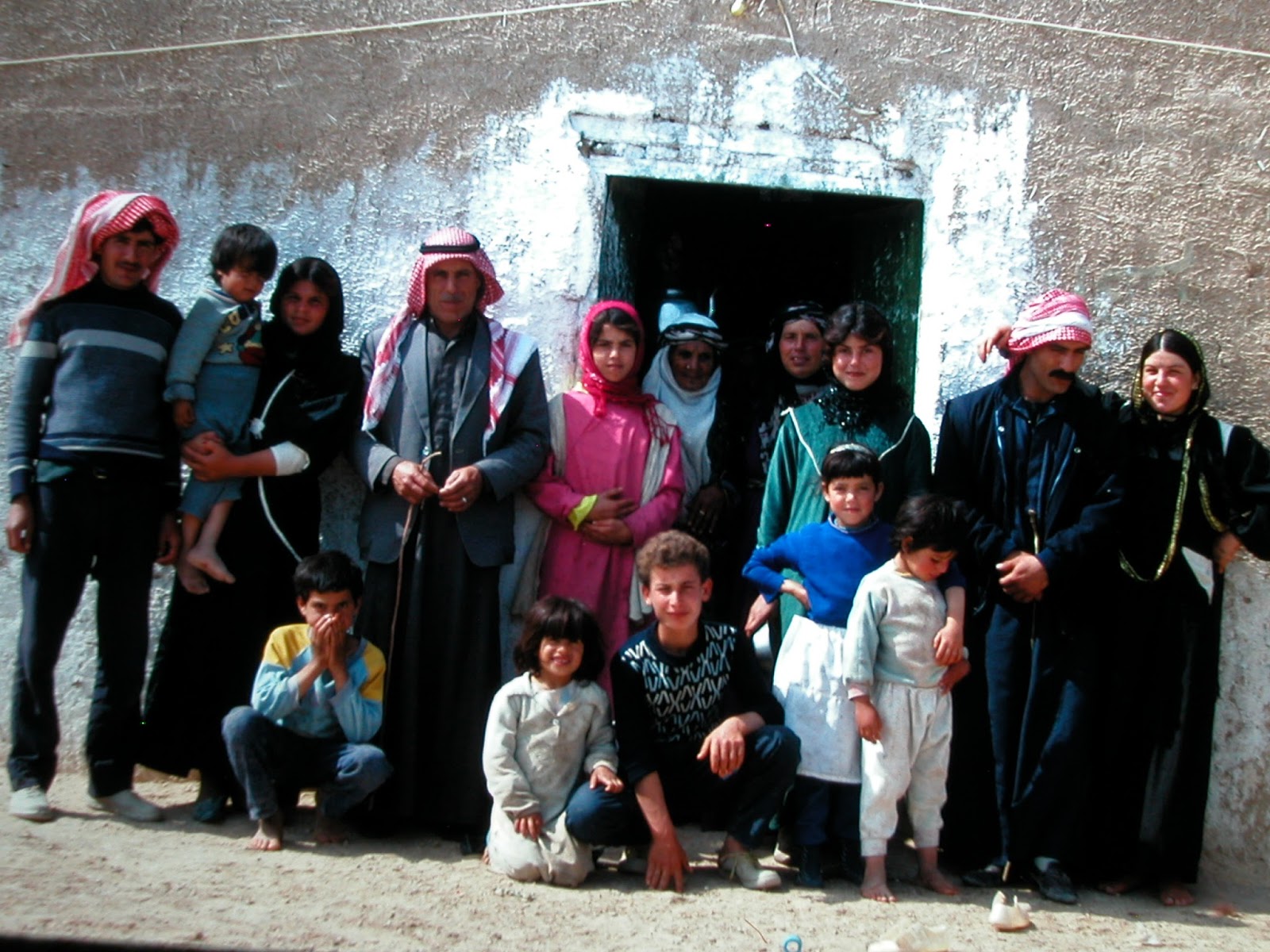
The Bedu of Tel ‘Atij (1992).


Our camp and dig house, Bedouin shepherd.
There is an old Yemeni saying that goes: Choose your neighbour before building your house, says the city dweller. Choose your companion before choosing your route, says the nomad. This proverb may especially hold true for a community of nomads that lived in the upper reaches of the Fertile Crescent in North-Eastern Syria. In 1992, I had the pleasure of working and living amongst a group of sedentary Bedu in the village of Tel ‘Atij. As an ethnoarchaeologist, I had to, overtime, grapple with the impending fate that lay ahead for these Bedu of Tel ‘Atij, whom I had become friends with. In a way, they became my Bedu.
L-R Our camp and the tents, Tel 'Atij. 
I spent a little over three months in the field, working on a salvage archaeological site on the Khabur River in north-eastern part of Syria. A salvage archaeological site means that the historical record and material culture will be lost forever and we will be the last ones to dig here. I would be excavating in Mesopotamia—that land that lies between the two greatest rivers in antiquity, the Tigris and the Euphrates.
I had been fascinated by the ancient Near East since I first travelled to these lands in 1982. From there, I enrolled in my first class in Near Eastern Archaeology at the University of Calgary. My professor, Dr. Celeste Peters, had studied the long lost languages of Akkadian and Sumerian at the University of Toronto’s Near Eastern Studies program. She inspired me to pursue this profession and even recommended me to another Canadian professor from Laval who was running a dig in Syria. How could I resist?
Our Bedouin caretaker and family.
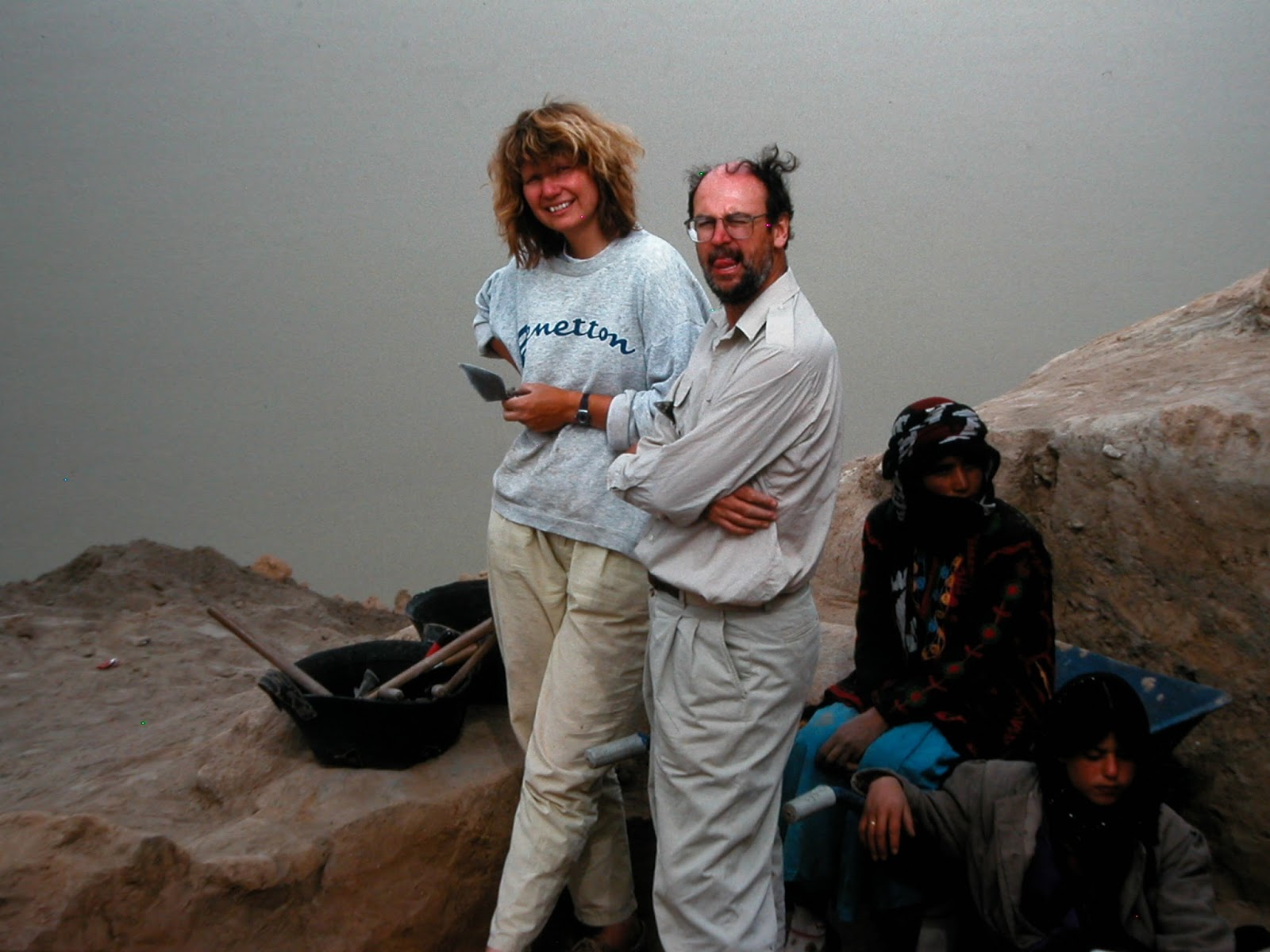
Our team consisted of four student site supervisors (three of them PhD candidates), a photographer, an old Cypriot surveyor, a renowned palaeoethnobotanist, a student architect and the mudhir (the boss)and his family. Along with the other three grad students, I would also be a "site supervisor" which was unusual since I was only a lowly undergrad at the time. In addition, we had a support staff that included a Syrian Antiquities officer who was a Druze, an Aramaean Syrian cook, a Bedouin night watchman and his wife, and a Bedouin caretaker who lived with his family at the back of our dig house. All told, there could be almost twenty of us around the dig house at any one time.
We feasted on a diet which included mounds of rice pilaf, all-you-can eat stuffed grape leaves, endless French fries, and fresh baguettes, croissants, and other fresh-baked delights from Hasseke's bakery. This was a carry-over from when the French ruled here after the Sykes-Picot Agreement.
 The dinner conversations were as varied as the food that we dined on daily as there was polyglot of languages spoken at our table—Arabic, English, French and Aramaic. Our Bedouin workers were suspicious of our cook—they were suspicious of anything or any one who was not from their village—because her spoken Aramaic sounded quite similar to their Arabic, but they couldn't actually understand what she was saying. Moreover, to heighten their suspicions, our cook would speak in hushed tones to her friends and family who came from Hasseke to visit her from time to time, dressed in provocative clothes, even in high heels.
The Aramaeans are part of the Syrian Orthodox Church who probably fled from Turkey during the past few centuries to escape the pogroms against Christians by the over-zealous Turks. The Syrian Christians differed from their Muslim compatriots both in dress, customs, religious freedom and morals. This was quite evident when we would drive into the nearest town of Hasseke, on our days off and we would be shocked at these brazen Christian girls who walked around scantily clad in hip-hugging blue jeans and eye-catching halter tops trying to walk in high heels almost causing our Druze antiquities driver guy to have an accident in our VW van.
Muhammad, our handyman.
Our living accommodations consisted of Syrian army tents pitched on platforms of concrete, and a mud brick dig house without air conditioning where we ate and wrote up our daily notes. There was also a porch whose shade provided relief from the blazing afternoon sun and from where we enjoyed viewing Syrian sunsets whilst sipping our sundowners. Some year’s back, a perimeter mud-brick wall had been built to protect us against neighbouring packs of vicious pariah dogs, deadly scorpions and poisonous snakes that were common in this part of the Syrian Desert. Unfortunately, this did not stop the huge, venomous ankabotha (camel spider) from climbing over the wall and wreaking havoc on our Syrian tenting experience. Being a fearless sort (at times) it was my duty to try and roust these blighters before the womenfolk entered their lodgings for the night. In my own tent, I had a symbiotic relationship with the spiders as I felt they would keep the more sinister looking scorpions at bay. by eating them However, this did not allay any fears amongst lesser souls in our camp!
Night watchman at Gudeda site.
The landscape around our camp was stark and desperate to say the least. This should hardly come as any surprise since the northern Syrian Desert has been this way for at least 5,000 years. It’s funny what you find out from archaeology, which is essentially a destructive science, but maybe a necessary evil in trying to understand the past—especially if we know very little about it in the first place. Take for instance, our site—Tel ‘Atij. If one were to look at where we were going to excavate, one would get a different perspective of how things might have looked in the past. The top of the tel offered me the best vantage point for miles around. A tel is the Arabic word for a man-made mound or hill, which is formed by the accumulated remains of ancient settlements covered in sand which was our job to remove. As I stood on the top of our tel, all I could see was a very dry, almost treeless and an unbelievably flat piece of land stretching as far as the eye could see, until interrupted by a bump on the horizon, which usually signalled another tel.
However, during the course of excavations, we found the carbonized remains of acorns that could only have come from great stands of oak trees, which would have covered this part of the Akkadian Empire in antiquity. One day, Dr. Joy McCorriston, our paleoethnobotanist, and I sat on the tel and discussed the likelihood of this parched land before us once covered in deep, cool oak forests. It was hard to imagine a single oak tree here let alone a grove. According to Joy, the closest oak trees were to be found 70 kilometers north of here on the slopes of the Taurus Mountains in nearby Turkey.
Local Bedouin kids.
Standing in the merciless afternoon sun it was difficult to envision that this bleached, dun landscape had once been verdant and alive with birds. However, now there was but one lonely tree that stood out on the dusty foreground. It was perhaps the last living monument to past glories and an important landmark for the village community. It offered the only sanctuary from the sun after a hot day in the fields or a cool spot to have a lunch with your family or to meet a friend. The reality was that no matter which direction you came from, all the dusty tracts led to one place—the tree. It was a visible focal point for the Tel ‘Atij village life and probably for their folklore. I never actually sat under it, but from time to time, I would often see people sitting under it.
I shared the tel with Lisa Cooper, one of candidates for PhD, and our job was primarily to coordinate excavation, record any artifacts found, tag and bag them, and to supervise local our Bedouin workers. As “site supervisors”, we were in charge of roughly seventeen workers and over the course of the season we excavated some six meters of soil from Tel ‘Atij. None of the workers understood a stitch of English, and me, with only a smattering of Arabic, communicating with each other was going to be a challenge. It was a great start! Ha.
L-R Hani, baby Muhammad, our helper, Linda, junior architect.
Located on the east bank of the Middle Khabur River, Tel 'Atij, it is one of 60 sites which were destined to be flooded after the completion of a downriver dam four years hence, and time was running out for the villagers. As an archaeologist, I understand the complexities of revealing a buried civilisation through the excavation of their associated material culture. Yet, during excavation, I pondered the fate of my fellow village workers. The dam would not only impact these 60 sites, but, more profoundly, the Bedouin's traditional way of life. I feared that  these village Bedu will end up like their hapless kinfolk who live in squatters tents on the outskirts of Hasseke and Damascus, and ultimately lose their tribal identity. As an ethnoarchaeologist, I felt that these questions needed to be addressed before the ethnohistorical record of these Bedu, who live along the banks of the Khabur River, are lost forever to the flooding waters.
Lisa's workers
Initially, what changed my mind was a discussion that I had with one of my workers, Ali, during a particularly hot morning of excavating. He was one of my better workers , and had been a pick man on previous digs, and for this he was given the privilege of being the pick man. My usual work day started with me stumbling out of my camp cot at four am, shaking the scorpions out of my Israeli-made boots, tripping over tent lines in the dark, chasing a few mangy pariah dogs out of the compound, mixing Nido, and eating crunchy Turkish corn flakes. Next came organising the crews, fighting over tools, the exchange of hostilities with unwanted workers, then heading up to the tel and try to get my crew to do most of the grunt work before the blistering Syrian sun fried us all to a frazzle. However, this day was different. There was a commotion at the site and the air was alive with electricity. The workers were more vocal than usual—which was hard to imagine because they were a noisy lot to begin with! The racket seemed to be emanating from Lisa's area next to mine, so I asked a worker what all the hubbub was about.
Lisa Cooper and the mudhir, Prof Fortin

Apparently, Lisa’s oldest worker, Aishe, had his six-week-old baby die suddenly in the night. The commotion and chatter was thus explained—the ensuing discussion had been over where the young body would be buried. I found out later that it was considered a great honour to be asked to attend the burial and even greater, to be asked to shovel or toss dirt into the grave. Everyone was related to everyone else in this small village and as a result, they all petitioned Lisa and me to let them participate in the burial. However, we had a job to do and the workers were paid to work, and not to take time off for a burial regardless of who it was.  Lisa had allowed Aishe to attend to the burial, but no others.
Two of my workers, Ali and Abdul got into a shouting match with me over this: they in their broken English, and me in my poor Arabic. They both implored me, ‘Min fadlak Emerse. Mumkin rua gabr ’ (Please, Emerson. We want to go to the burial).
Local Bedouin kids.
‘Not on your life! Forget it and get back to work!’ I replied, and in Arabic, ‘Bas. Khalas. Shugul kathir. Yallah!’ (Enough. Finished. Lots of work. Let’s go!)
My stern reply made Abdul back off, but Ali continued, ‘Min fadlak, Emerse.' (Please, Emerson). He was starting to grovel. At this point I wanted no part of this charade.‘La! Inta lazem hoen, la hanek ’, I said, raising my voice. (No, you are needed here, not there!) And before Ali could answer, I laid down the law, ‘Mafi shugul, mafi faluus!' (No work, no money!)
My four words struck terror into Ali's heart. Ali’s eyes widened and he realized that it was futile to try and argue the point anymore. Both Ali and Abdul knew that I commanded the mudhir’s ear and that I could have either of them fired for the slightest infraction. Not that I would ever do such a thing, but over here, I had the wasta (influence), and besides, I dearly wanted their respect as their boss. I was not the dig's head honcho overall, but on this site, this day and every day—I was at the top of the pecking order. My job was to make the rules and their job was to obey.
Things eventually subsided. Like it or not, Ali and Abdul realized that my word was the law. I was "He who must be obeyed." I gave them my parting shot on the subject of taking off for a burial. ‘Inta majnuun? Shugal lazem!’ (Are you crazy? Work is necessary!)
My crew
To my amazement, Ali shot back, ‘La, athzar majnuun !’ (No, archaeology is crazy!). He continued to pick away meticulously at our crumbling 2,500-year-old mud brick wall.
Meanwhile, my mind was reeling as I pondered his heartfelt statement. Suddenly I realized, here I was imposing my will, my North American work ethic on these Bedu’s way of life. My workers endured a seven-hour day under the hot sun, before heading back to their homes for lunch, after which they worked in their own fields till sundown. Somebody had died, a relation no less, and here I was forbidding the two of them to not to attend a funeral. Who the hell was I? Was I really an unsympathetic bastard? I didn't recognize what I was becoming. It could be said that my attitude bordered on being rude—at any rate, it was downright culturally insensitive. What the hell kind of an anthropologist cum ethnoarchaeologist was I starting to become anyways? Ali's comment that 'archaeology was crazy' had caught me out. Moreover, I knew he was absolutely right. 
I started sweating buckets, so I went up to the top of the tel to catch a cool breeze and to sort out the storm in my mind. But once on top, I saw Aishe’s relatives trying to dig the grave for his daughter, but without a shovel. I could see a procession heading to the burial site being led by Aishe who was carrying his pitifully small bundle wrapped in a traditional white burial sheet. The gravity of the situation dawned on me—life here on the Syrian steppe is harsh and unforgiving in a way we western people can't really appreciate, medical treatment is hours away if there is any at all. There was always a line up of local villagers would come from miles around to our ‘dig house’ in the hopes that we would provide medicine or medical help for their particular ailment. The professor’s wife (mudhira) was usually doling out free medicine for the locals. I suppose if a traditional cure was not successful then it was Inshallah, the will of Allah. Such is the fate of a village Bedouin.
Finally, after some serious soul searching and reflection, I climbed back down our rickety ladder to where Ali and Abdul were still busy working. I called them over. I supposed they feared that I was going to fire them. ‘You are right,’ I said to Ali. ‘Athzar majnuun.’  (Archaeology is crazy.) Then I took a gulp, ‘You and Abdul can go to the burial’. Ali looked up at me, and for the first time in days, he was actually smiling. Both men kissed my hand as a sign of respect then thanked me profusely and the womenfolk on both sites nodded approval. As a way of endearing myself further to them, I told them to take a pick and shovel to help Aishe dig the grave. They were just about to leave the tel when I noticed a huge discarded white limestone slab that might have been the lid on one of our excavated Ninevite 5 burials c. 3000 BC. I knew that this tradition was still in use as modern burials often use an old limestone slab as a burial marker on a tel. Both Ali and Abdul jumped at this suggestion,  I helped them load the heavy slab into a wheel-barrow, and told them to get it in one piece to the grave.
My confrontation had taught me a greater lesson than just human respect for life and that I was not so omniscient after all. This experience had both humbled me and made me look deeper at the reality of our excavation here and at archaeology in general. It reminded me of one of my first lectures on archaeology that was given by Dr. Scott Raymond at the University of Calgary in 1989. In summing up his hour-long lecture, Dr. Raymond concluded that, ‘Quite simply, archaeology is a destructive science and in order to understand a site, one must destroy it.' 
Three of our Bedouin workers from Tel 'Atij.
At our Tel ‘Atij site, the sequence was, first you excavate to expose a mud brick wall or down to a supposed floor surface or wall, then you articulate the feature and from this record, you photograph, collect, tag and bag all the material culture that was exposed then survey it for its provenience. After this is done, you begin the whole destructive process again. No wonder Ali thought archaeology was crazy—it was!
Here we were, in the middle of nowhere with overwhelming dust and heat, excavating a long abandoned tel for remnants of the structures of dead people built by people who had left no written record. We know very little about these Ninevite 5 folk except of what we can extrapolate from a few pottery sherds, some broken-down pots that have been left on a vacant floor that has been subsequently buried under meters of sand and numerous destruction periods. While visions of plumbobs danced round in my head, I was brought back to reality by the noise of a screeching wheelbarrow that Ali and Abdul were using. I stood up and yelled after them—‘Allah Karim!’ (Allah be Merciful). I hoped that it was not too late for a little mercy for myself. On this day, I changed my opinion on archaeology to one of ethnoarchaeology—I was more interested in the people who I was working with, the Bedouin, than they people we were excavating.
                                                        *             *             *           

Lisa  Cooper and her crew.
Our workers were not paid a lot by western standards, but by Syrian accounts, this pay was nothing short of a windfall. Upon our arrival at Tel 'Atij, news got out that we were looking for local labourers and they came from far and wide. Fathers brought their sons, mothers brought their daughters, uncles came with their brothers, and in-laws jostled with out-laws in the line-ups. The thought of extra money would translate into additional staples like grain, rice or sugar plus some luxuries such as, tobacco or some new material for the unmarried daughter’s trousseau. Pay day was another exciting day with all the relatives coming to watch the goings-on. There was the usual banter over who got what and how much. There was also haggling going on between husband's and wives particularly between those who both worked on the site. The working wives always wanted to keep more money for themselves and their kids than for their husbands—after all, they worked for it.
My oldest worker Muhammad and me.
Smoking on the site was strictly forbidden, yet, the worst offenders were my older women who smoked like chimneys. I was forever telling ‘my girls’, who worked harder than the men, that if they wanted to smoke they would have to do so off the tel. The ash from cigarettes creates problems for archaeologists, especially when one is trying to get uncontaminated carbon samples for C14 (radiocarbon) dating. On one occasion, my favourite pick man, Muhammad, was entrusted to pick out carbon samples from a layer of destruction material in my section. In order to collect a carbon sample, one needs to be quite meticulous as you don’t want any contamination of the black ash either by human hands or cigarette ash. Muhammad was very conscientious about retrieving the carbon sample, and one morning I set him to work extracting the ash with a cooking spoon and collecting it carefully in aluminium foil. I told Muhammad to take his time and do it slowly.
‘Shway, shway!’ I said. (Slowly, slowly)
He concurred, ‘Aiwa, shway, shway!’
 As he handed me a large and desirable piece of 4,000-year-old carbon on the spoon, I noticed on the end of his 1992 Syrian-made, Reem cigarette that he had his own giant ash—so much for my carbon sample. I had to toss it.


Last day of work: Lisa and my crew's doing the dubke dance.
I remember the last day of the dig when Lisa and I brought our used clothing and other goodies for the workers to have as parting gifts. By mistake, I brought three packs of Reem cigarettes that I thought they could share. This was not to be. Everything was going smoothly until I came to the three packs of cigarettes. I intended to hand out the packages which I thought they would divide amongst themselves. Instead there was almost a full-scale riot over the cigarette packs because each smoker wanted a whole pack for themselves. After my protestations, they did indeed become orderly and shared the cigarettes amongst themselves.
The memories of my friendly workers and their traditional Bedouin hospitality will be forever etched in my mind and in my heart. Moreover, I had often been welcomed into their mud brick homes, snacked on dibbis (date spread) and khubbs (bread) with my fingers, shared mensaf (rice pilaf with chicken) with our landlord, drank endless cups of chai, talked politics, shared a laugh with them, danced to Kurdi music in their homes, and in the end cried with them as we embraced each other in the traditional Bedouin farewell.
 Like the mysterious Ninevite 5 people before them, the history and their stories of these Bedu of Tel 'Atij too will be lost to the murky waters of the Middle Khabur. I considered my workers as good friends, but most of all, as my Bedu.
I only hope that they choose wisely between their new “neighbour” in the city or the new “companion” that will be needed for their unknown route ahead of them.
                                               *            *            *   
Since the 1990’s, the Syrian government has embarked on mega water control projects and dams along the Middle Khabur River basin. This put at threat, many ancient sites and of course, the people living there like my Bedu of Tel 'Atij. Consequently there was a proliferation of these salvage archaeological projects. Near Eastern archaeologists were commissioned to excavate any possible sites that the dam system would endanger, in fact, that was what we were doing at Tel 'Atij. In recent times, a number of scholars and political experts have prophesied that the next war in the Middle East will not be over land, but over water. (* The emergence of IS has changed that as they are at war over land)
The Turkish government funded by IMF had already built the massive Ataturk Dam on the Euphrates River on Turkish soil and therefore controlled the flow of water into Syria. The effect of that was that the Syrians started their own dam projects. The problem is that with the building of these dams, the local Bedouin would have to be displaced—but, to where?
The majority of these Bedouin had originally been forced to settle here in the Khabur Basin during the mid-1950’s by the Syrian Baathist government under Michel Afleq .
Roving Bedouin workers who harvested wheat for locals.
Now, these same Bedouin were being forced to uproot their stable village life once again to relocate perhaps to a city where they would exchange their comfortable mud brick homes and sheep pens for noisy crowded streets with no livestock, just cold, concrete apartment blocks. Very little had been written about their plight and I had been warned by the professor not to write for fear of retribution: both to myself and more importantly, on the Bedouin. I feel I have remained silent long enough on this issue.
                                                     *            *            *

Afterword

Bedouin shepherd in nearby town of Hasseke
My professor later updated me; the Syrian government changed its mind and will now either (a) offer the Bedu money to buy land, or (b) give them a parcel of land outright. Originally, the government had loaned the Bedu this land in the hopes that these nomadic pastoralists would then settle in an area where the government could then control their movements and undoubtedly tax them. The land in the Khabur Basin, that’s destined to be flooded, is by far the best arable land in northern Syria, and it has been cultivated seasonally as far back as perhaps 4,000 BC! Moreover, many of the Bedu villagers that I talked to, planned to take the money, leave their traditional mud-brick houses and move into cinder block houses in the nearby city of Hasseke.
Some of our Bedouin workers.
In doing so, the Bedu will have abandoned a lifeway that has existed down through the millennia. These Bedu had settled down to village life in Tel ‘Atij after generations of a nomadic lifestyle on the unforgiving Syrian Desert. Yet, the villagers still harbour mistrust of outsiders, particularly those who have no tribal affiliation. As a carryover from their nomadic days, they have their brutish mastiffs, some with studded collars, that in previous times, they were used to ward off desert wolves and hyenas, and more importantly, to scare off any intruders who might try to steal their livestock. I thought it was odd that they would retain this tradition since the wolves and hyenas were probably long gone, and everyone in this vicinity were related after all. This distrust of the other reminds me of an old Bedouin proverb—
“Me and my brother against our cousin. Me, my brother and my cousin against the stranger.”